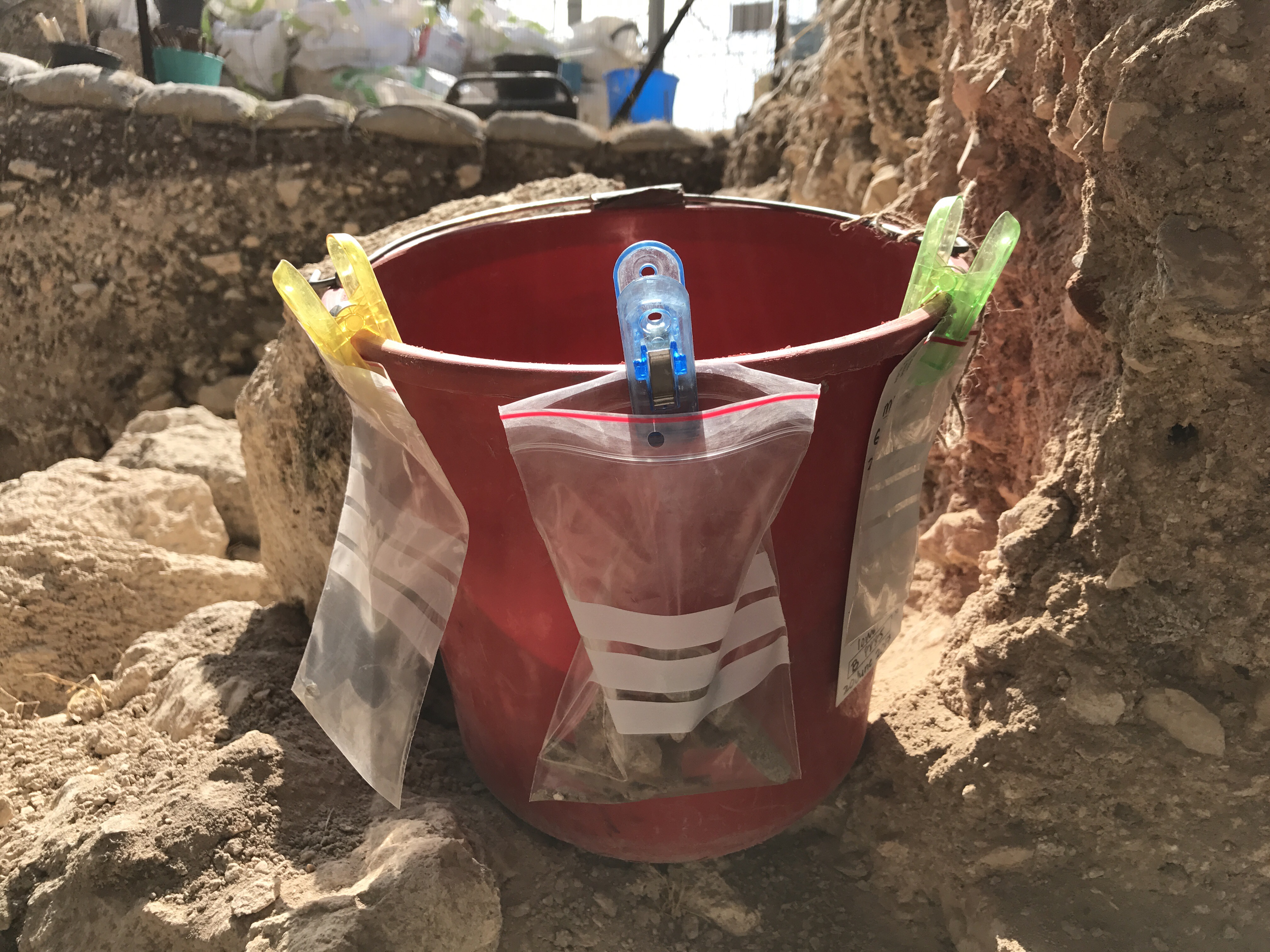
They go in a “find” bucket or a plastic bag — those things the archeologists want to and often find. They are called by the genetic word find. They could be shards of pottery, remnants of shells, prices of metal or pieces of charcoal. Their presence tells us a lot about life back then.
Some finds, like pottery shards, are placed directly in the bucket. Others are presorted into plastic bags.
Every bucket is catalogued with a reference system that can tell future researches the exact location the item was found.
Sophisticated surveying equipment, including precision laser sensors, can precisely locate a particular find or carefully map out a specific area (loci), to help archeologist recreate a 3-D virtual representation of the site. Sometimes where an item is found is just as important as what was found.
Finding something, as exciting as it is, is only the first step in a long, involved process to determine a find’s significance and value.
Many finds today. Many more to come!
 Clemans Travelogue
Sounds complicated! G lad you two are enjoying yourselves. Be safe!
LikeLiked by 1 person
Von: thanks for sending this. Know you are “in heaven” with all of this! (even moreso as–I suspect–that with your scientific background and knowledge, your ego is being boosted frequently by your being a “reference source”!).
All quiet on this “Local Front”. Best to you and Marion. Bo Roddey
LikeLike
You are welcome, Bo. It’s really hard manual labor. High interest level and Aleve are seeing me through.
LikeLike